
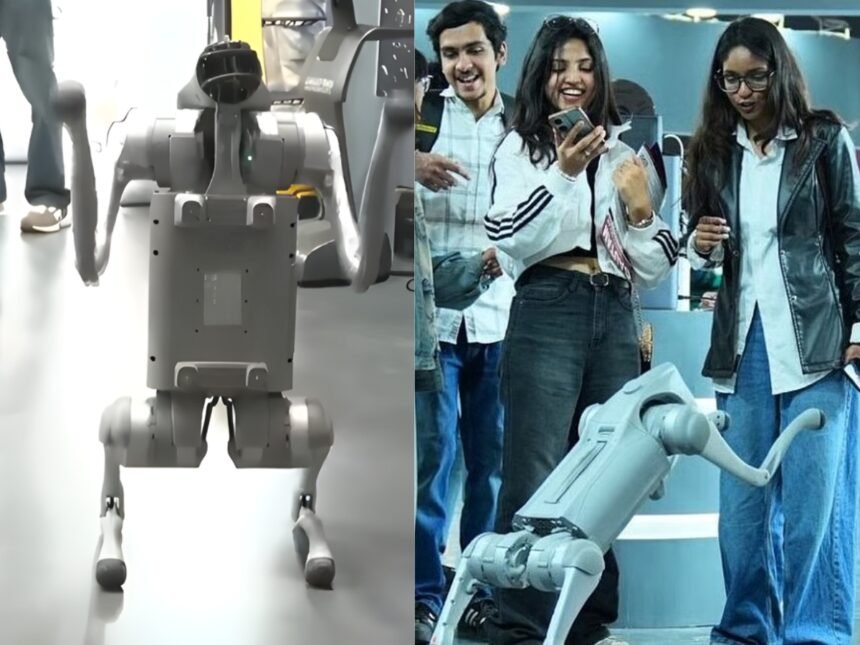
Galgotias Robot Dog Controversy, What happens when cutting-edge tech, national pride, and a little bit of branding collide on a public stage? That’s exactly what we just saw at the India AI Impact Summit in New Delhi, where Galgotias University landed in the spotlight for all the wrong reasons.
A robotic dog, presented as “Orion” and showcased as a product of the university’s own Centre of Excellence, turned out to be a Chinese-made Unitree Go2. Once social media connected the dots, the backlash was swift, the video went viral, and the university was reportedly asked to vacate the expo area.
Let’s break down what actually happened, why it matters, and what this episode says about India’s push for home-grown AI innovation.
Background: Galgotias At The India AI Impact Summit
The India AI Impact Summit in New Delhi was meant to be a showcase of innovation, collaboration, and forward-looking technology. Institutions, startups, and global tech players gathered to highlight how AI can reshape industries and societies.
In the middle of all this, Galgotias University from Greater Noida set up its stall, aiming to display its work in robotics and AI. Among the exhibits, one showstopper stood out: a four-legged robot dog, introduced to visitors and the media as “Orion”, supposedly developed by the university’s Centre of Excellence.
The Robot Dog At The Centre Of The Storm
Galgotias Robot Dog Controversy, “Orion” looked impressive. It walked, moved, and performed tasks like the advanced quadruped robots we’ve seen in viral tech videos.
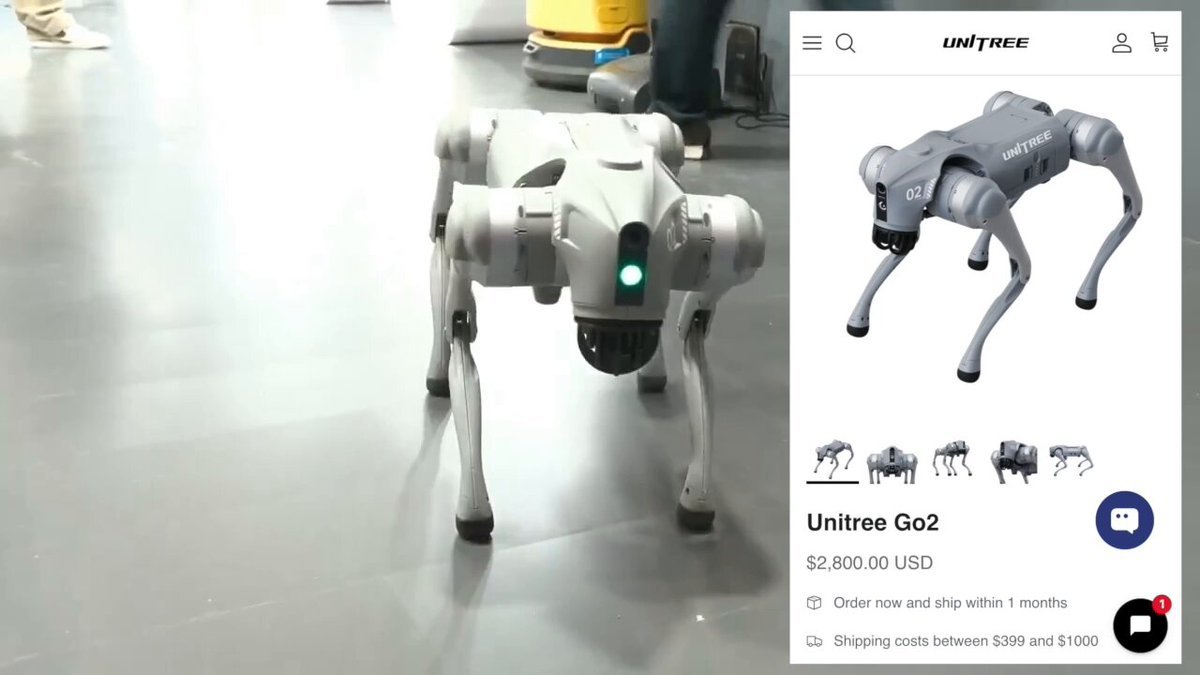
However, tech-savvy viewers quickly noticed that this wasn’t a mysterious new Indian invention. The robot matched the design and functions of the Unitree Go2, a well-known robotic dog manufactured by the Chinese company Unitree Robotics.
The Unitree Go2 is not some secret prototype. It’s a commercial product that can be purchased online in India, generally priced between Rs 2 lakh and Rs 3 lakh, depending on the configuration. So when people realised “Orion” looked exactly like a Unitree Go2, the questions started pouring in.
The Viral Video: ‘Orion’ Presented As A Galgotias Innovation
The turning point came when a video from the summit went viral on social media. In the clip, a woman identified as a Galgotias University representative enthusiastically explains the robot dog’s capabilities to the media.
She introduces the robot as “Orion” and clearly states that it was developed by Galgotias University’s Centre of Excellence. That’s not a subtle implication; it’s a direct claim of in-house development.
In another video from an interview, a university professor reinforces this narrative, again suggesting that the robot had been built at the university’s Centre of Excellence. For viewers, it sounded like a proud declaration of Indian innovation. For those familiar with the Unitree brand, it sounded like something else entirely.
Social Media Fact-Check: ‘These Robot Dogs Are Chinese, Not Indian’
Galgotias Robot Dog Controversy, It didn’t take long for social media users to connect the dots. Within hours, posts started appearing comparing “Orion” to the Unitree Go2, highlighting identical design elements, movement patterns, and visible branding.
Users began calling out Galgotias for allegedly passing off imported technology as an indigenous creation. Phrases like “These robot dogs are Chinese, not Indian” echoed across X (formerly Twitter), Instagram, and other platforms.
In an era where online communities fact-check in real time, the narrative shifted almost overnight—from “Look at this Indian innovation” to “Is this an attempt to rebrand a Chinese robot as a Made-in-India product?”
Immediate Fallout: Galgotias Asked To Leave The Expo
According to sources, the reaction from the summit organisers was quick. Galgotias University was asked to vacate the expo area of the India AI Impact Summit.
For an institution hoping to showcase its tech credentials on a national stage, being told to pack up and leave is a serious reputational blow. It doesn’t just raise questions about one robot; it raises questions about the institution’s transparency, internal controls, and how it presents its work to the public and the government.
This also sent a loud message to other exhibitors: misrepresenting or exaggerating tech claims at such high-profile events can carry real consequences.
Galgotias’ Official Response: ‘It’s A Learning Tool, Not Our Creation’
Under pressure, Galgotias University issued a formal statement on X. The tone shift dramatically from the confident on-camera claims se in the viral videos.
The university clarifie that the robot dog had be procure from Unitree and was being use purely as an educational and research tool for students. It stressed that the institution had never officially claime to have built the robot itself.
The statement describe the robot dog as “a classroom in motion”, emphasising that students were using it to experiment, test its limits, and expand their knowledge. It added, in clear terms, that Galgotias had not built the robodog and had not claimed to do so.
The core argument was: yes, the robot is importe, but it’s there to help build the minds that will eventually design, engineer, and manufacture similar technologies in India.
The Community Note: X Users Call Out The Contradiction
Galgotias Robot Dog Controversy, The story didn’t end with the university’s clarification. The post on X soon attracted a Community Note—a feature that allows users to add context when a claim appears misleading or incomplete.
The note flagged the university’s assertion that it had “never” presented the robot as its own creation. It point out that the robot had be rename “Orion” and that university representatives had explicitly state on camera that it had be develop by their team and their Centre of Excellence.
In other words, the online community effectively said: the official line doesn’t match what your own people said on video. The contradiction only fuelled further criticism, leaving the university struggling to regain control of the narrative.
University’s Pushback: ‘Propaganda Campaign’ And Miscommunication
In a later statement, Galgotias University describe the backlash as part of a “propaganda campaign” against the institution. This suggest that the university believe there was an organise effort to target its reputation.
At the same time, one of the key figures in the controversy, Neha—a communications professor at the university’s School of Management—offered her own explanation. She argued that the incident stemmed from a misunderstanding.
According to her, there might have been a misinterpretation of what she intended to say in her media interaction. She stress that she is a communications faculty member, not an AI expert, and implied that her words may have been taken out of context or not fully understood. She added that the robot was brought to the expo solely for “projection”, not as a claim of original Indian hardware.
Faculty Clarification: ‘I Could Not Convey It Well’
Galgotias Robot Dog Controversy, Neha’s clarification gives a glimpse into how internal communication and media training can make or break public perception. She said that either she had not expressed herself clearly, or the audience had misunderstood her intent.
She emphasised that the university was “standing tall” despite the online storm and insisted that the purpose of bringing the robot was to showcase it, not to deceive.
Still, when you’re speaking on camera at a prestigious summit, every word counts. A casual or imprecise statement can quickly be interpret as a claim of ownership or authorship—especially when attache to a visible, brand piece of technology.
Larger Questions: Innovation, Ethics, And National Image
This isn’t just a story about one robot dog. It touches on bigger questions that India faces as it pushes for leadership in AI and robotics.
First, there’s the issue of transparency. Is it acceptable for universities or companies to rebrand imported tech and present it as their own work? Even if the intention is to say, “We’re working with this tool,” the line between showcasing and claiming can blur very quickly in public communication.
Second, there’s the emotional layer: India is investing heavily in “Make in India” and indigenous innovation. When a foreign product is pass off—or even perceive as be pass off—as a local breakthrough, it jars with that national narrative. It’s like putting someone else’s signature on your painting.
Third, there’s a lesson in media handling. In an age where every interaction can be record, clip, and share, institutions need to be extremely clear and consistent about what they claim.
Why This Matters For Students And Universities
Galgotias Robot Dog Controversy, this incident is a reminder that reputation is as important as raw skills. You can work with the best tools in the world, but if your institution’s credibility comes into question, it reflects on everyone associated with it.
For universities, the takeaway is simple but powerful: be honest and precise about what you’ve built and what you’ve bought. There is absolutely nothing wrong with using imported technology as a learning aid. In fact, that’s how many institutions stay up to date. The problem begins when the messaging blurs that line.
A robot dog can be an incredible teaching platform. It can help students understand locomotion, control systems, AI algorithms, and human–machine interaction. But calling such a device your own “innovation” when it’s not can turn a teaching opportunity into a PR disaster.
Official Word On Eviction: ‘No Such Information’
While multiple sources indicate that Galgotias had be aske to leave the expo area, there was a degree of ambiguity on record.
Galgotias University Professor Aishwarya Shrivastava comment on reports that the university had be told to vacate, saying, “As of now, we have no such information.”
This left room for speculation. Were organisers handling the matter quietly? Was the university trying to limit further embarrassment? Or was there a gap between what sources report and what the institution was willing to confirm publicly?
Similar Articles: India AI Impact Summit 2026 Chaos: Inside the Opening Day Mess
Conclusion
The Galgotias robot dog controversy is a textbook example of how quickly things can unravel when communication, credibility, and technology collide. A robot bought as a learning tool, renamed “Orion”, and showcased at a prestigious summit, ended up becoming a symbol of overclaiming and under-clarifying.
From viral videos and fact-checks to official statements and community notes, the entire episode unfolded in full public view. Whether you see this as deliberate misrepresentation, a communication failure, or a mix of both, the fallout has been very real.
As India races ahead in AI and robotics, this incident underlines a simple truth: trust is as important as technology. You can import machines, but you can’t import credibility—you have to build that yourself, step by step, with transparency and honesty.