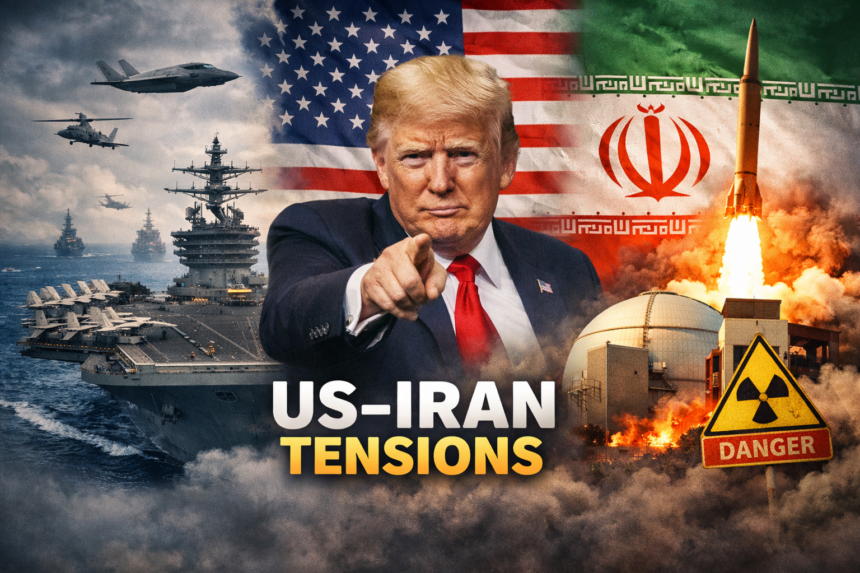
US–Iran Tensions, the United States and Iran find themselves facing off on a dangerous edge. On one side are missiles, warships, and the looming threat of airstrikes. On the other are ongoing signals about negotiations and the desire to “make a deal.”
Former US President Donald Trump claimed he sent a “big armada” to the region while also insisting that Tehran actually wants to talk. Confusing? That’s exactly how many observers feel.
This confrontation blends military pressure, strategic posturing, and behind-the-scenes diplomacy. Let’s unpack what’s going on, why it’s significant, and what Trump says he stopped — particularly regarding Iran’s nuclear ambitions and regional influence.
Trump big armada near Iran has become a central phrase in discussions about rising US–Iran tensions and the renewed focus on military strength combined with diplomatic negotiations.
Trump’s ‘Big Armada’ Comment: Flexing Military Muscle
Trump publicly bragged about deploying a “big armada” close to Iran — a phrase clearly meant to send a warning. This wasn’t just talk. The deployment included a carrier strike group led by the USS Abraham Lincoln, along with advanced fighter aircraft and support forces.
Shifting such firepower isn’t like moving a few vehicles. It’s more like placing a fully armed chessboard directly in front of an opponent and daring them to misstep. The message was unmistakable: military action was ready if needed.
A Situation ‘In Flux’: Why The US Hesitated
Trump described the Iran situation as being “in flux,” which essentially meant chaotic, risky, and unpredictable. Earlier that same month, he reportedly came very close to approving strikes inside Iran.
The catalyst was the Iranian government’s violent crackdown on protests, which US officials claimed resulted in thousands of demonstrators being killed.
Despite pressure from Washington, Trump ultimately chose to hold back on launching airstrikes. Instead, he reinforced the US military presence while delaying direct action. The protests were crushed, but uncertainty about how far the US would go remained.
Behind Closed Doors: Trump’s Options And Internal Debate
US–Iran Tensions, When questioned, Trump refused to reveal specific military plans discussed by his national security team or which option he favored. That silence was telling.
It suggested that multiple scenarios were on the table — ranging from limited attacks to a much broader military campaign.
Inside his administration, opinions were sharply split. Hawkish advisers urged him to enforce his red lines, especially after he promised to support Iranian protesters and punish the regime.
Others pushed for restraint, questioning what bombing Iran would actually achieve. Would it topple the government, or would it spark a long, bloody regional war?
Diplomacy Still On The Table: ‘They Want To Make A Deal’
Even amid the threat of war, Trump repeatedly returned to one message: he believed Iran wanted negotiations.
“They want to make a deal. I know so. They called on numerous occasions. They want to talk,” Trump said.
This fit perfectly with his self-image as a master dealmaker. While brandishing military power, he framed the standoff as leverage — pressure Iran enough and they’ll agree to tougher terms.
The core idea: the US had overwhelming force but preferred a negotiated settlement.
What Washington Wanted From Tehran
So what did the US expect from any new agreement?
Officials made it clear that any deal would be far stricter than previous ones. Their demands included:
Removing all enriched uranium from Iran
Limiting Iran’s long-range missile stockpile
Ending Iran’s support for proxy groups across the Middle East
Banning independent uranium enrichment entirely
In short, Washington wanted to roll back Iran’s nuclear program, restrict its missile power, and weaken its regional influence.
Tehran indicated it was open to discussions — but showed no willingness to accept such sweeping conditions.

Iran’s Response: Willing To Talk, Not To Surrender
Iranian leaders made it clear that dialogue was possible, but they refused to signal any surrender of strategic capabilities.
From Iran’s point of view, giving up enriched uranium and ending enrichment would mean losing its main leverage.
That’s why talks remained fragile. Both sides expressed interest in diplomacy while clinging tightly to their red lines.
The result was a tense situation where war and negotiation ran side by side, like parallel trains headed toward an uncertain future.
The 12-Day War And The ‘Big Force Of Missiles’
Trump also referred to the brief but intense 12-day war in June, describing it as a major turning point.
He claimed that before the conflict, Iran had a “big force of missiles” capable of launching a devastating surprise attack on Israel.
According to Trump, allowing Israel to strike first prevented a far worse scenario. He said the first day of fighting was brutal for Iran, wiping out key leaders and destroying many missiles.
In his narrative, that early Israeli assault shattered Iran’s ability to launch a powerful surprise strike.
‘If There Was A Different President…’: Trump’s Nuclear Claim
US–Iran Tensions, Trump went even further, asserting that under a different president, Iran would already have nuclear weapons.
He argued that Tehran might have even launched an attack first.
This sweeping claim was meant to reinforce what he saw as the success of his maximum-pressure strategy — including sanctions, military threats, and backing Israeli strikes.
In Trump’s view, this hard-line approach blocked Iran from going nuclear and prevented a major regional conflict.
How Close Was Iran To A Bomb? Intelligence Estimates
Before the 12-day war, US and Israeli intelligence reportedly believed Iran could move extremely fast if it chose to build a weapon.
Their estimates suggested:
Two weeks to enrich enough weapons-grade uranium
Four to six months to assemble a basic nuclear device
These projections alarmed both Washington and Jerusalem.
Even if Iran wasn’t openly rushing toward a bomb, the ability to do so quickly gave Tehran significant leverage.
Later US and Israeli strikes heavily damaged Iran’s nuclear facilities, though officials admitted the exact status of Iran’s uranium stockpile remained unclear.
The infrastructure took major hits — but the full picture was still uncertain.
US Military Build-Up: Carriers, Jets, And Air Defenses
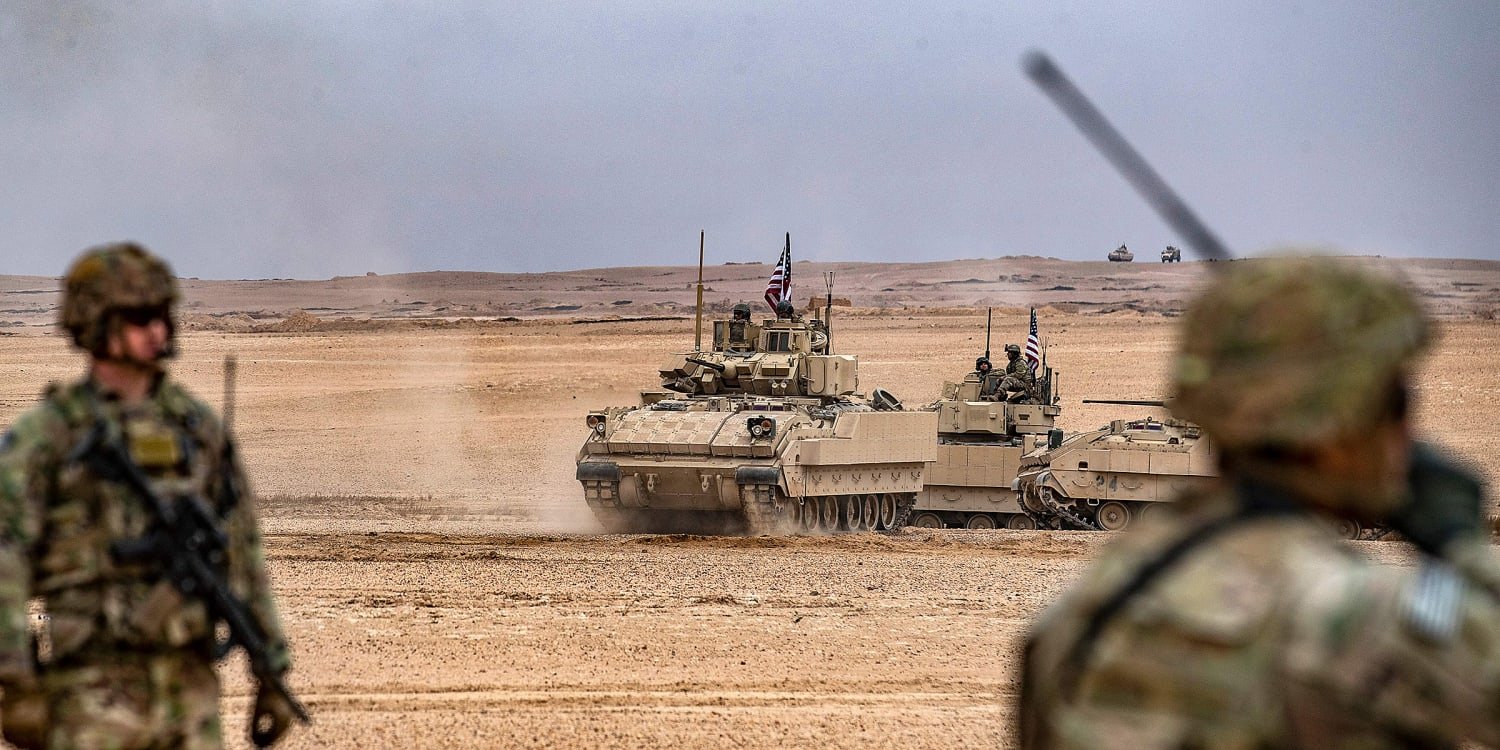
As political debates continued, the US military quietly prepared for possible conflict.
Beyond the USS Abraham Lincoln carrier group, Washington deployed:
Additional F-15 and F-35 fighter jets
Extra aerial refueling tankers
More air defense systems
These weren’t symbolic gestures. They were essential components for a potential large-scale military operation — providing strike power, extended range, and layered protection.
CENTCOM–Israel Coordination: Preparing For An Iranian Strike
Coordination extended beyond US forces.
Admiral Brad Cooper, head of US Central Command (CENTCOM), traveled to Israel to meet top military officials.
Sources said the discussions focused on joint planning and defensive measures in case Iran retaliated.
The message was unmistakable: the US and Israel were fully aligned.
Any Iranian attack on Israel would be met with a coordinated response, combining intelligence, missile defense, and possibly offensive action.
Similar Articles: Iran Full-Scale War With West Declared Ahead of Trump-Netanyahu Meeting
Conclusion
US–Iran Tensions, the Trump-era US–Iran standoff looked like a dangerous balancing act.
On one side, the US positioned carriers, jets, and missile defenses, and nearly launched strikes over Iran’s protest crackdown and regional behavior.
On the other, Trump repeatedly stressed that Iran wanted a deal, implying diplomacy could still prevail.
Iran showed openness to talks but rejected Washington’s sweeping demands.
Intelligence warnings about Iran’s rapid nuclear potential raised the stakes even higher.
The 12-day war and subsequent attacks weakened Iran’s capabilities but failed to eliminate tensions entirely.
Ultimately, this wasn’t about a single speech or military deployment — it was about a fragile equilibrium.
Heavy military pressure was used as leverage for diplomacy, with the constant risk that one miscalculation, one missile, or one misunderstanding could push the region from brinkmanship into full-scale war.