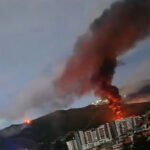

Venezuela Blasts, Imagine waking up to the sound of explosions and seeing flames light up the night sky. That’s exactly what happened during the Caracas explosions early Saturday morning in Venezuela’s bustling capital. Multiple blasts rocked the city, sending shockwaves through quiet neighborhoods and painting the skyline with thick columns of grey smoke as the Caracas explosions shattered the early-morning calm.
Videos flooding social media captured terrifying scenes — buildings engulfed in flames and people rushing for cover as loud booms echoed across the capital. Some residents even reported sounds resembling fighter jets roaring overhead, amplifying fears of a potential attack.
Mystery Surrounds the Explosions
So far, officials haven’t confirmed the exact cause or locations of the explosions. Panic spread quickly as rumors swirled online. Some local sources said a massive blast occurred near Higuerote Airport, located in northern Venezuela’s Miranda state. But the full picture remains murky, with no official statement pinpointing responsibility.
Colombian President Sounds the Alarm
As news broke, Colombian President Gustavo Petro wasted no time sharing his concerns. In a dramatic post on X (formerly Twitter), he declared, “They are bombing Caracas… They have attacked Venezuela with missiles.” Petro’s words hit like a thunderclap, sparking fresh international attention. He called urgently for the United Nations to convene, warning that the world cannot ignore what he described as an “attack.”
The U.S. Response: Silence but ‘Awareness’
Meanwhile, the U.S. government acknowledged it was “aware” of reports about explosions and unusual aircraft activity above Caracas. But Washington has yet to confirm or deny involvement. That caution hasn’t stopped speculation, especially given the tense backdrop of recent U.S. military activity in the region.
Trump’s Caribbean Task Force: A Prelude to Action?
Let’s rewind a bit. For weeks now, Donald Trump’s administration has been turning up the military heat in the Caribbean. The former president deployed a U.S. Navy task force to counter what he’s long described as Latin American drug cartels operating out of Venezuela and nearby waters.
This move wasn’t an isolated decision — it’s part of a broader anti-narcotics campaign that analysts say could double as a veiled message to Venezuelan President Nicolás Maduro. The military buildup has fueled speculation about whether Washington might be preparing for more direct intervention.
The First Strike: Venezuela’s Docking Area Hit
Venezuela Blasts, Just a few days before the Caracas explosions, Trump announced that U.S. forces had destroyed a docking facility allegedly used by Venezuelan drug traffickers. He described it as a major blow in America’s campaign against regional narcotics smuggling. That assault, reportedly conducted on Venezuelan soil, was viewed by many as the first step toward a possible land operation.
Ongoing Strikes in the Caribbean and Pacific
Since September, the U.S. military has intensified its maritime strikes, targeting boats in both the Caribbean Sea and the eastern Pacific Ocean. Washington claims these vessels are part of a vast network channeling illegal drugs toward North America, often under the protection of state-backed groups. Each successful intercept, U.S. officials say, reinforces their determination to dismantle the trade at its root.
Trump vs. Maduro: The Drug War Narrative
This latest chapter in U.S.–Venezuela relations feels like déjà vu. Trump has repeatedly accused Nicolás Maduro of being the head of a drug cartel, using Venezuela’s governmental cover to shield traffickers and fund his regime. In response, Maduro has fiercely denied these allegations, branding them as a politically motivated smear designed to justify American aggression.
Maduro insists the real reason behind Washington’s hostility isn’t drugs — it’s oil. Venezuela holds the largest proven crude reserves on Earth, making it an irresistible geopolitical prize. According to him, the U.S. wants to destabilize and eventually overthrow his government to gain access to those riches.

Tensions Boil Over in Latin America
Venezuela Blasts, Whether or not the explosions in Caracas were connected to U.S. military operations, there’s no denying one thing: tensions across Latin America are skyrocketing. Governments across the region are now keeping a close eye on developments, especially as accusations fly between Venezuela, Colombia, and the United States.
If Petro’s warnings are accurate, this could mark a new escalation point — not just a drug war, but the precursor to a regional conflict involving multiple nations.
Fears of Escalation: Could This Turn Into War?
That’s the question on everyone’s mind. Could this be the beginning of a larger confrontation? History has taught us that small military operations often spiral into prolonged standoffs. The world has seen this movie before — with the same cast, different scripts. And once hostilities begin, it’s rarely easy to turn back.
Political analysts warn that a direct U.S. attack on Venezuela would upend decades of delicate diplomatic balance in Latin America. Russia, China, and Iran — known Venezuelan allies — would likely condemn the move, possibly offering Caracas military or financial support.
The Human Cost: Civilians Caught in the Middle
Lost in the headlines are the millions of Venezuelans already struggling with economic hardship and political chaos. For them, these explosions bring fresh fear and uncertainty. Another conflict, they worry, could push the country deeper into turmoil. As one Caracas resident told a local reporter, “We just want peace — no more destruction.”
Global Reactions Pour In
While the U.N. has yet to issue an official statement, several nations have urged calm and restraint. European diplomats have called for investigations into the blasts and reminded all parties of the region’s fragile peace. The world watches — waiting for answers, hoping the next headline isn’t about an all-out war.
Similar Articles: Iran Full-Scale War With West Declared Ahead of Trump-Netanyahu Meeting
Conclusion
Venezuela Blasts, Whether accidental or deliberate, the Caracas explosions have become a global flashpoint. They reveal just how volatile the intersection of politics, military power, and resources can be. Trump’s campaign against alleged drug cartels may have opened a new front in Latin America’s already tangled geopolitical landscape.
For now, smoke still rises over Caracas, and questions continue to swirl. Was this a criminal act, a military operation gone wrong, or the first spark of a regional war? One thing’s for sure — the world won’t look away anytime soon.