
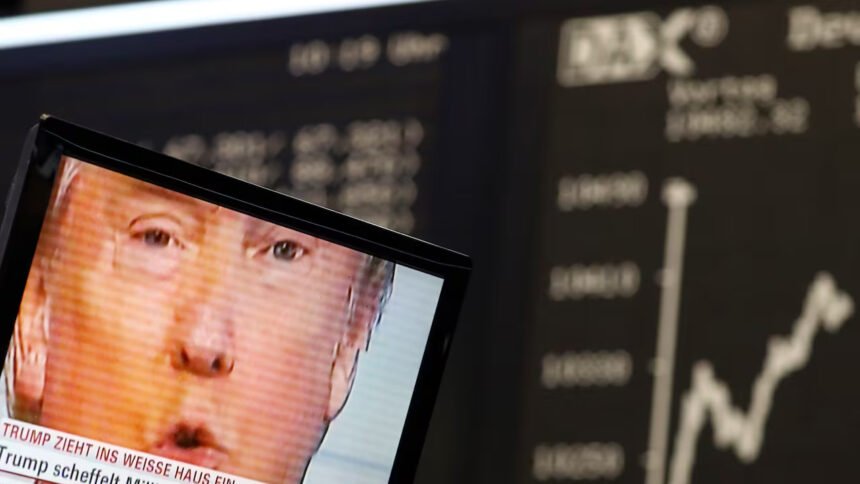
US stock market sell-off, US markets took another hit on Friday in January 2026, and this time, it wasn’t just about earnings or a random headline. The Dow Jones Industrial Average, the S&P 500, and the Nasdaq Composite all slipped into the red, while traditional safe havens like gold and silver also suffered steep declines.
So what triggered this broad-based sell-off? In simple terms: a surprise political move, a shift in interest rate expectations, and a sudden jolt in the US dollar all collided at once.
Let’s unpack it step by step.
Key Market Moves: Dow, S&P 500, Nasdaq All Slide
The trading day started with a clear negative tone:
-
The Dow Jones Industrial Average fell 139.16 points, or around 0.28%, to close near 48,932.40.
-
The S&P 500 slipped 0.29% to about 6,949.07.
-
The tech-heavy Nasdaq Composite dropped 0.35% to roughly 23,602.81.
On paper, those percentage moves might not scream “crash,” but they came on top of rising volatility, nervous sentiment, and aggressive repositioning across multiple asset classes. The real story lies in why investors suddenly hit the sell button.
Interestingly, even with this pullback, all three major indices still look poised to lock in gains for January 2026. That’s why many strategists see the move less as a meltdown and more as a sharp recalibration.
Trump’s Shock Fed Nomination: Why Kevin Warsh Spooked Markets
US stock market sell-off, The biggest catalyst for Friday’s slide came from politics rather than earnings:
President Donald Trump announced on Truth Social that he has nominated Kevin Warsh, a former Federal Reserve Governor, to replace Jerome Powell as Fed Chair.
Why does this matter so much?
Because the Fed Chair effectively sets the tone for US monetary policy. Markets trade not just on what’s happening now, but on what they think the Fed will do in the months and years ahead.
Kevin Warsh is widely known for:
-
A hawkish lean in the past
-
Criticizing the Fed’s prior money-printing and ultra-loose policy
-
Warning that inflation risks were often underestimated
More recently, Warsh has shown a pragmatic side, publicly signaling some openness to interest rate cuts—a stance that aligns with the White House’s desire for easier financial conditions. But investors aren’t sure which version of Warsh will show up if inflation flares again: the strict inflation-fighter or the more flexible dove.
That uncertainty alone is enough to shake markets.
Rising Yields And A Stronger Dollar: The Real Squeeze On Stocks
US stock market sell-off, Once Trump’s nomination hit the tape, the bond market reacted quickly.
-
10-year Treasury yields climbed as traders priced in the possibility of a less dovish, more inflation-wary Fed.
-
The 30-year yield pushed toward 4.9%, a level that makes investors sit up and pay attention.
-
The US Dollar Index (DXY) strengthened, reflecting expectations of a relatively firmer policy stance.
Why do these moves matter for stocks?
Think of interest rates like gravity for financial markets. When long-term yields rise:
-
Borrowing becomes more expensive for companies and consumers.
-
The present value of future corporate earnings (especially for growth stocks) falls.
-
Investors might shift from riskier equities into safer bonds offering more attractive yields.
Growth and tech names, which rely heavily on expectations of strong future cash flows, are especially vulnerable when yields jump. That’s part of why the Nasdaq and broader growth segments underperformed.
At the same time, a stronger dollar tightens global financial conditions, hurts US exporters, and often pressures commodities priced in dollars.
Why Gold And Silver Crashed Along With Stocks
Here’s where things got even more interesting: safe-haven metals didn’t act all that safe.
-
Gold tumbled more than 4%, sliding to around 5,115–5,120 USD per ounce.
-
Silver plunged nearly 13%, dropping to roughly 99–100 USD, after recently hitting a record peak near 121.78 USD.
On the day:
-
Gold futures (GC00) were down about 4.40%, losing more than 235 USD per ounce.
-
Silver futures (SI00) fell around 12.43% to about 100.21 USD.
What caused the “free fall”?
-
A stronger dollar makes gold and silver more expensive for non-US buyers, dampening demand.
-
Rising yields raise the opportunity cost of holding non-yielding assets like gold. If bonds suddenly offer higher returns, some investors move out of bullion.
-
Positioning in metals had become stretched after strong rallies driven by:
-
Expectations of rate cuts
-
Ongoing central bank buying
-
Geopolitical risks that kept safe-haven demand elevated
-
Once the dollar jumped and yields climbed, many traders rushed to take profits. That rush turned into a kind of mini “liquidity event,” particularly in silver, as leveraged positions were unwound in a hurry.
The metals sell-off didn’t stop there. It:
-
Hit mining stocks and materials shares,
-
Shook confidence among investors who saw gold strength as a signal of underlying market stability.
Instead of calm, the sudden slump in bullion reinforced a growing sense that financial conditions are tightening again.
Biggest Winners: AI, Storage, And Select Tech Defy The Drop
US stock market sell-off, not every stock suffered. A few names staged standout rallies, powered by earnings surprises, AI momentum, and sector-specific themes.
Here are some of the top gainers:
-
Sandisk (SNDK): +20.32% to 648.88 USD
-
The driver: earnings blew past estimates, and the company projected a massive 70% hike in memory prices for 2026.
-
Why it matters: In the AI era, storage is like the “oil” of the digital world. Sandisk has effectively become the “AI king” of January, with shares up over 1,000% from 2025 lows.
-
-
Verizon (VZ): +6.41% to 42.36 USD
-
The driver: upbeat Q4 guidance and a surprise addition of 616,000 wireless subscribers.
-
Takeaway: Defensive telecom exposure plus strong subscriber growth gave investors a reason to hide out here.
-
-
La Rosa Holdings (LRHC): +51.84% to 4.54 USD
-
The driver: a speculative wave hitting small-cap real estate tech.
-
Caveat: The stock remains very volatile, trading within a wide 52-week range.
-
-
ENvue Medical (FEED): +17.19% to 4.50 USD
-
The driver: ongoing momentum in healthcare tech, supported by positive clinical data and sector rotation into medical innovation.
-
These moves underscore an important point: even in a shaky macro environment, stock picking still matters. Strong stories connected to AI, health tech, or subscriber growth can buck the broader trend—at least for a while.
Biggest Losers: Commodities, Mortgage Lenders, And Crypto Feel The Pain
On the flip side, plenty of names took heavy hits, especially in sectors sensitive to rates and the dollar.
Some of the notable losers:
-
Silver (SI00): -12.43% to 100.21 USD
-
The driver: a “liquidity wipeout” as the stronger dollar and rising yields triggered forced selling.
-
Context: Silver fell from a record high near 121.78 USD earlier this month, marking one of its steepest single-day drops in months.
-
-
Gold (GC00): -4.40% to 5,119.20 USD
-
The driver: Warsh’s hawkish reputation lifted the dollar and yields, making non-yielding gold less attractive.
-
Impact: The size of the intraday drop—over 235 USD per ounce—sent shockwaves through precious metals traders.
-
-
Rocket Companies (RKT): -11.70% to 18.34 USD
-
The driver: 30-year Treasury yields flirting with 4.9%. Higher long-term rates spell trouble for the mortgage and housing market, weighing heavily on Rocket’s refinancing and originations outlook.
-
-
Bitcoin (BTC): -1.85% to about 83,033 USD
-
The driver: a broad “risk-off” shift as Fed leadership uncertainty triggered a wave of deleveraging.
-
The Nasdaq Crypto Index fell around 1.70%, and roughly 1.7 billion USD in leveraged long positions were liquidated as traders rushed for the exits.
-
The common thread? Assets tied to liquidity, leverage, or rate sensitivity were among the hardest hit.
Trade Threats Return: Tariffs Back On The Radar
US stock market sell-off, As if monetary policy uncertainty and commodity volatility weren’t enough, trade tensions crept back into the narrative.
President Trump signaled several potential moves:
-
A possible 50% tariff on aircraft imports from Canada.
-
Threats to decertify new jets from firms like Bombardier, arguing that Canadian rules unfairly block US-made Gulfstream jets.
-
Hints that Mexico could face new tariffs tied to oil shipments to Cuba.
No immediate policy steps have been taken yet. However, markets remember well that rhetoric alone can move prices. Even the mere suggestion of higher tariffs:
-
Raises questions about supply chains and manufacturing costs.
-
Puts pressure on industrial, aerospace, and transportation stocks.
-
Fuels concerns around global growth, particularly at a time when valuations are already elevated.
When investors are already nervous about rates and policy shifts, renewed trade war chatter can feel like throwing gasoline on a smoldering fire.
Earnings: Apple Disappoints The Mood, Sandisk Steals The Show
Earnings season added another layer of complexity.
-
Apple (AAPL) shares fell about 2%.
-
The company actually beat profit expectations, thanks to record iPhone sales.
-
The problem? CEO Tim Cook warned about a global memory shortage, which could squeeze margins in coming quarters.
-
That cautious tone spilled over into the broader tech sector, reinforcing worries about supply constraints.
-
Meanwhile:
-
Sandisk emerged as a major bright spot, surging more than 20% on the day.
-
Strong forward guidance and booming demand tied to AI and data centers fueled the optimism.
-
Yet, as strong as Sandisk’s rally was, it wasn’t enough to offset the macro headwinds dragging down broader indexes.
-
This tug-of-war between solid micro stories (individual companies) and fragile macro sentiment (policy, rates, trade) is exactly what defines late-cycle, late-stage bull-market behavior.
Are US Indexes Still On Track For January Gains?
US stock market sell-off, Here’s the twist: despite Friday’s volatility, the bigger picture isn’t all doom and gloom.
-
The S&P 500 and Nasdaq Composite remain higher for the week and on track for gains in January.
-
The Dow Jones is only slightly lower for the month.
That suggests Friday’s move looks more like a sharp pullback than a full-scale meltdown. Think of it as the market taking a deep breath after sprinting ahead.
But under the surface, some warning signs are flashing:
-
Strategists at Bank of America point out that nearly 89% of global equity indexes are trading above both their 50-day and 200-day moving averages.
-
Historically, that kind of breadth often signals overbought conditions.
-
-
At the same time, investors have pulled more than 15 billion USD from equity funds in the past week.
-
That outflow hints at growing caution, even as headline indices remain near highs.
-
In plain English: prices are high, enthusiasm has been strong, but money is now quietly stepping to the side.
What This Means For Investors Right Now
So where does this leave everyday investors and traders?
A few key takeaways:
-
Policy uncertainty is back at center stage. The Fed chair nomination matters because rates are the backbone of asset pricing.
-
Higher yields and a strong dollar are pressuring not just growth stocks but also precious metals, housing-related names, and emerging risk assets like crypto.
-
Selective strength in AI, storage, healthcare tech, and certain telecom names shows that opportunities still exist—but broad index exposure may come with choppier swings.
-
Trade threats could reintroduce a theme markets thought they had mostly left behind, namely tariff wars and supply-chain friction.
In this kind of environment, investors often:
-
Reassess how much interest rate risk and currency risk they’re really carrying.
-
Rotate between sectors—away from the most rate-sensitive areas and toward businesses with strong pricing power or secular growth drivers.
-
Pay closer attention to risk management, instead of assuming that every dip will be bought instantly.
Similar Articles: Silver Price Today Surges as Demand Soars Across Global Markets
Conclusion
US stock market sell-off, gold, and silver was a strong reminder that markets are still heavily tethered to policy expectations and macro narratives.
Trump’s nomination of Kevin Warsh for Fed Chair jolted assumptions about the pace and timing of 2026 rate cuts, igniting a surge in Treasury yields and a stronger dollar. That combination weighed on:
-
Major equity indices like the Dow, S&P 500, and Nasdaq
-
Traditional safe havens like gold and silver
-
Rate-sensitive sectors such as mortgage lenders and housing-related stocks
At the same time, pockets of strength—especially in AI-driven tech, storage, and select healthcare names—show that this isn’t a market devoid of opportunity. It’s a market where macro tides can easily overwhelm even solid company-specific stories, at least in the short term.
For now, US indexes still appear poised to notch gains for January, underscoring that this episode looks more like a sharp correction inside a continuing uptrend, rather than the start of a full-blown crash. But with so many global equity indexes looking stretched and fresh money quietly exiting stock funds, investors would be wise to treat this as a warning shot.
When policy, trade, and inflation all sit in the same room, markets rarely stay calm for long.