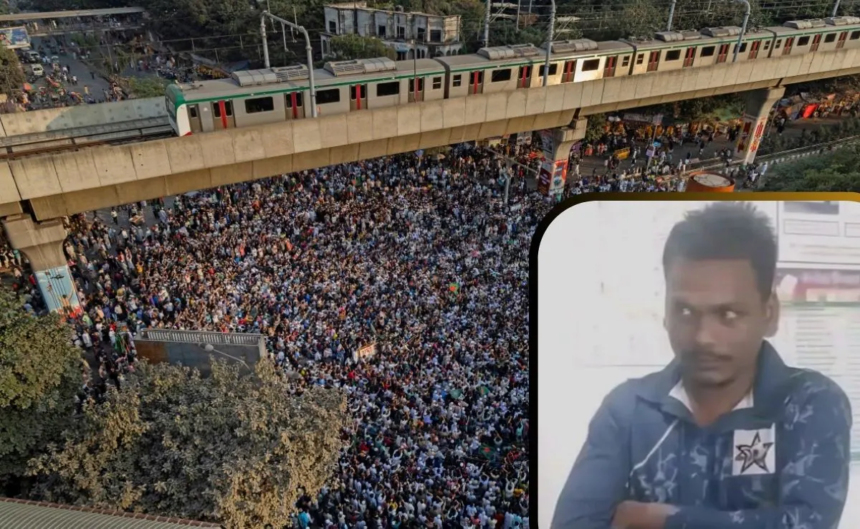
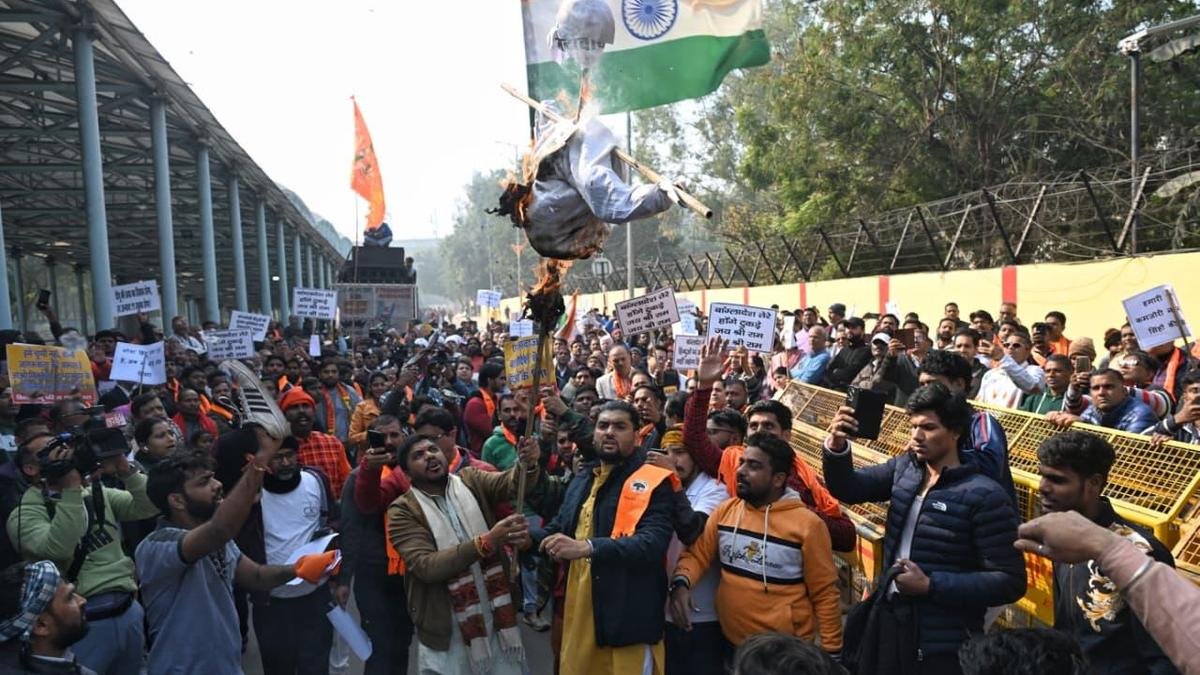
New Delhi woke up to scenes of chaos and confrontation on December 23, 2025, as thousands of protesters gathered outside the Bangladesh High Commission, turning a planned demonstration into a full-blown political flashpoint. The Bangladesh High Commission protest New Delhi quickly drew national attention as what began as an expression of anger over the killing of a Hindu man in Bangladesh escalated into violent clashes with police, damaged vehicles, detentions, and a ripple effect that stretched far beyond the streets of the Indian capital.
If politics is a pressure cooker, this protest was the steam whistling out loud and clear. Emotions ran high, tempers flared, and before authorities could regain full control, the incident had already created domestic political tremors and diplomatic unease between India and Bangladesh.
Why the Protest Erupted in the First Place
At the heart of the unrest lies the killing of Dipu Chandra Das, a Hindu worker in Bangladesh. His death, described by protesters as a mob lynching, struck a raw nerve among Hindu organizations in India, particularly those sensitive to the safety of religious minorities in neighboring countries.
For many demonstrators, this was not just about one tragic death. It symbolized a broader fear the vulnerability of Hindu minorities beyond Indias borders. The anger was visceral, emotional, and deeply personal. As one protester reportedly shouted, If we stay silent today, who will be next tomorrow?
VHP and Allied Groups Take the Lead
The protest was spearheaded by the Vishwa Hindu Parishad (VHP), along with several allied organizations. Their stated aim was simple: condemn the killing, demand justice from Bangladeshi authorities, and push the Indian government to take a stronger stand.
On paper, it was meant to be a peaceful demonstration. On the ground, however, it felt more like a tinderbox. Large crowds marched toward the Bangladesh High Commission, slogans echoed through the streets, and emotions spilled over faster than police could anticipate.
Barricades Broken, Police Clash With Protesters
Delhi Police had anticipated unrest and deployed heavy security, erecting barricades and positioning personnel around the diplomatic enclave. But anticipation does not always translate into control.
As the crowd surged forward, protesters broke through police barricades, leading to tense face-offs and physical clashes. Several police vehicles were damaged, stones were reportedly thrown, and multiple protesters were briefly detained to restore order.
For bystanders, the scene looked like a city holding its breath sirens blaring, officers forming human chains, and protesters refusing to back down. It was chaos, raw and unfiltered.
Opposition Reacts: Condemn Violence, Raise Bigger Questions
The political reactions were swift and predictable, yet telling. Opposition parties, including the Indian National Congress, condemned the violence outright. But they didnt stop there.
Opposition leaders questioned whether the government had done enough diplomatically to ensure the safety of minorities in Bangladesh. Some accused the ruling establishment of reacting emotionally rather than strategically, arguing that loud protests should not replace quiet but firm diplomacy.
In their view, protecting Indian interests abroad requires negotiation rooms, not street battles.
BJP Responds: Protecting Hindus Is a Priority
On the other side of the aisle, leaders from the Bharatiya Janata Party (BJP) emphasized their commitment to safeguarding Hindu communities worldwide. Party statements reiterated that the government was actively engaging Bangladesh on the issue and would continue to press for accountability.
The BJP framed the protest as a reflection of genuine public anger, while also distancing itself from the violence. Its a delicate balancing act acknowledging emotion without endorsing chaos.
With key state elections scheduled in 2026, political messaging around identity, security, and nationalism is already under the microscope.
Diplomatic Shockwaves: Bangladesh Summons Indian High Commissioner
Killing of Hindu Man in Bangladesh, Perhaps the most serious consequence of the protest was diplomatic. Bangladeshs Foreign Ministry formally summoned Indias High Commissioner, expressing deep concern over the safety of its diplomatic mission in New Delhi.
In diplomatic language, a summons is never casual. Its a red flag polite on the surface, serious underneath. Bangladeshs move signaled displeasure and demanded assurance that such incidents would not recur.
This development underscores a hard truth: domestic protests dont always stay domestic. Sometimes, they cross borders without a passport.
IndiaBangladesh Relations Under Strain
India and Bangladesh share a relationship built on cooperation trade, river water sharing, border management, and regional security. Over the years, both nations have worked hard to keep ties stable, even when disagreements arise.
Incidents like this test that stability. While neither side appears eager for escalation, trust can be fragile. Like a cracked mirror, it may still function, but the damage is visible.
Diplomatic sources suggest both governments are engaging behind the scenes to cool tempers and prevent long-term fallout.
Communal Sentiments and the National Conversation
Beyond politics and diplomacy lies a deeper issue communal harmony. Analysts warn that incidents like this can widen existing fault lines within society if not handled responsibly.
Communal narratives have become increasingly prominent in public discourse, and cross-border incidents often amplify them. When religion, identity, and politics mix, the result can be combustible.
Interestingly, on the same day, a political event in Chennai highlighted calls for religious harmony, reminding observers that Indias political landscape is far from monolithic. Multiple narratives coexist, often uneasily.
Government and Security Agencies Step In
In the aftermath, both the Central Government and the Delhi administration announced reviews of crowd-control and protest-management protocols. Officials reiterated a familiar but necessary line: peaceful protest is a constitutional right, violence is not.
The Home Ministry confirm that legal action would be take against those involve in damaging public property or assaulting personnel. At the same time, authorities assured Bangladesh that the safety of its diplomatic staff and premises remains a top priority.
Its a classic governance dilemma enforcing the law without appearing heavy-handed.
Timing Matters: Elections on the Horizon
Killing of Hindu Man in Bangladesh, This episode could not have come at a more sensitive time. With multiple state elections approaching in 2026, political parties are finely tuning their narratives. Incidents tied to religion, national identity, and foreign policy tend to resonate strongly with voters.
Political analysts believe the governments response over the next few days how it communicates, how it enforces accountability, and how it manages diplomacy could influence public perception well beyond this single event.
In politics, perception often matters as much as policy.
What Happens Next?
For now, the streets have calmed, but the conversation has not. Questions linger: Will justice be delivered in Bangladesh? Can India and Bangladesh prevent this from becoming a recurring flashpoint? And most importantly, can political leaders lower the temperature before the next spark flies?
Like embers after a fire, the risk of reignition remains.
Similar Articles: India and China Agree to Military De-escalation Along LAC: A Step Toward Stability
Conclusion
Killing of Hindu Man in Bangladesh, The protests outside the Bangladesh High Commission in New Delhi were more than a reaction to a tragic killing. They became a mirror reflecting Indias internal anxieties, political rivalries, and diplomatic responsibilities.
While the immediate violence has been contained, the broader implications communal harmony at home and diplomatic balance abroad are still unfolding. With elections approaching and public emotions running high, leaders on all sides face a crucial test.
Will they choose dialogue over discord, strategy over spectacle, and stability over short-term gains? The answer may shape not just the next news cycle, but the regions political climate in the months ahead.