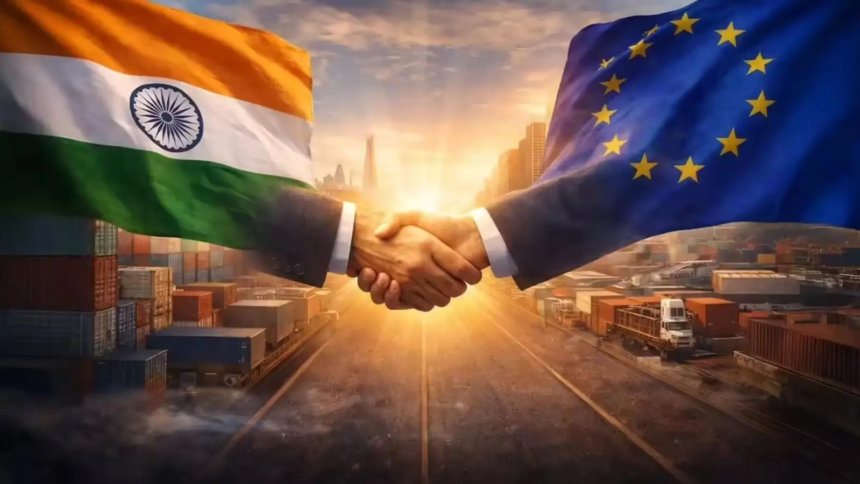
India EU Trade Deal, If you’ve been keeping even a casual eye on global trade politics, chances are you’ve heard the buzz around a huge trade agreement taking shape between India and the European Union. What started as quiet diplomatic chatter has now exploded into front-page news. With top EU leadership preparing to land in New Delhi, the proposed pact is already being branded as the “mother of all trade deals.” Big words — but not without reason.
This isn’t just another free trade agreement. We’re talking about a deal that could reshape trade flows, influence security cooperation, and alter geopolitical equations for decades. The combined market involved? Nearly 2 billion people and close to one-fourth of global GDP. Let’s unpack what’s unfolding, why it matters, and what both sides stand to gain.
At the heart of this transformation lies the India EU free trade agreement, a landmark pact designed to deepen economic integration, unlock investment opportunities, and redefine India-EU trade relations in a rapidly changing global order.
Let’s unpack what’s unfolding, why the India EU free trade agreement matters, and what both sides stand to gain as this historic partnership moves closer to reality.
The Big Moment: EU’s Top Leadership Heads To New Delhi
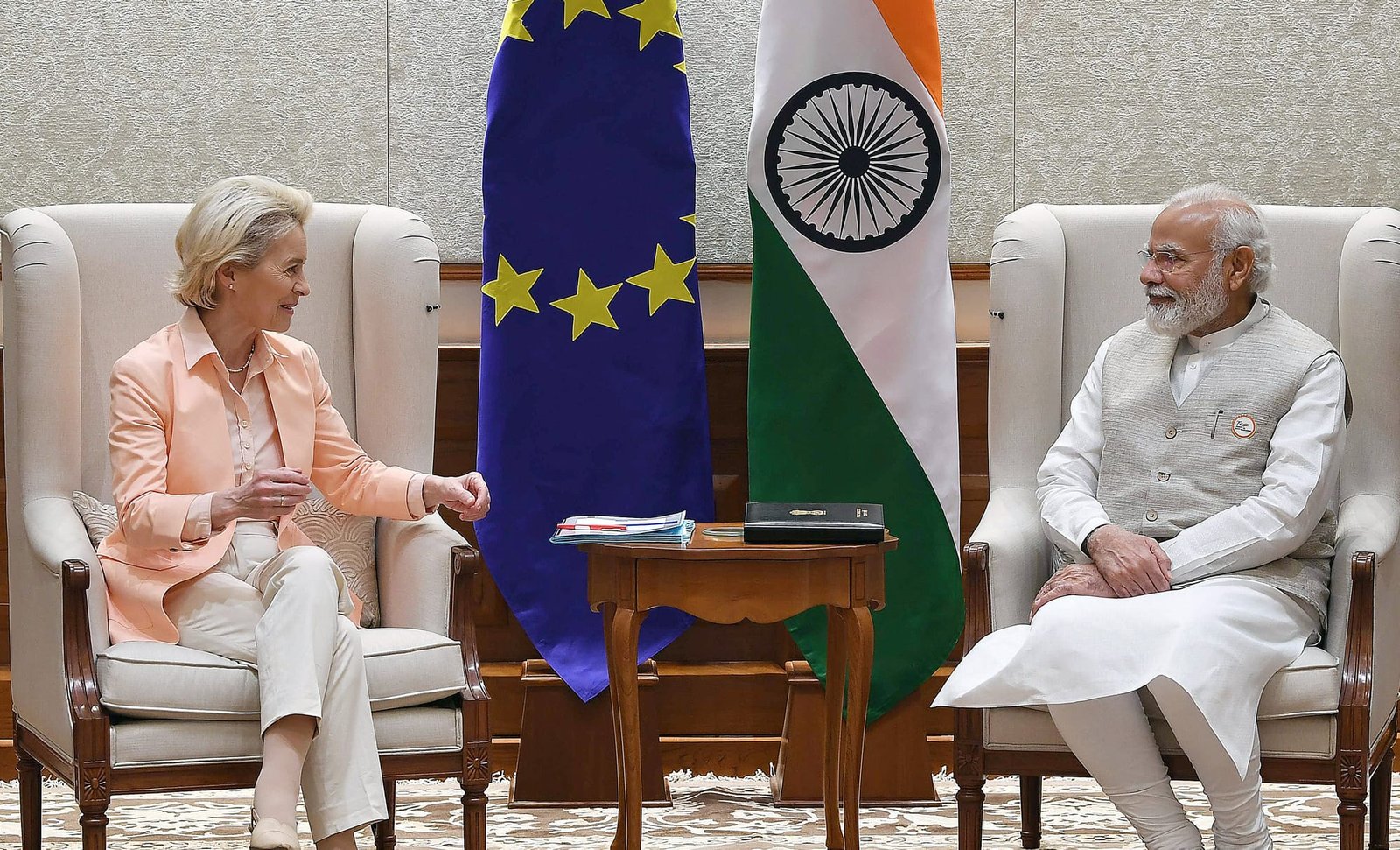
The spotlight is firmly on India as European Commission President Ursula von der Leyen and European Council President Antonio Costa prepare for their official visit from January 25 to 27.
This isn’t a symbolic stopover. During their stay, they will:
-
Serve as chief guests at India’s Republic Day celebrations
-
Hold high-level summit talks with Prime Minister Narendra Modi
-
Potentially announce the conclusion of negotiations on the long-pending India-EU Free Trade Agreement (FTA) on January 27
In diplomatic language, this is about as high-profile and high-stakes as it gets.
‘Mother Of All Deals’: The Statement That Set The Tone
Speaking at the World Economic Forum (WEF) in Davos, Ursula von der Leyen delivered the line that grabbed global attention:
“We are on the cusp of a historic trade agreement. Some call it the mother of all deals.”
She underlined why the agreement is so significant, noting that it would:
-
Create a unified market of nearly 2 billion people
-
Represent around 25% of global GDP
-
Give Europe a first-mover advantage in one of the fastest-growing and most dynamic regions worldwide
The message was unmistakable: Europe doesn’t want a ringside seat — it wants to be in the game.
Europe’s Bigger Strategy: Chasing The Growth Engines
India EU Trade Deal, Von der Leyen’s remarks also offered insight into the EU’s broader trade playbook. As she put it, Europe wants to do business with the growth centres of today and the economic powerhouses of this century.
That strategy includes:
-
Strengthening ties with Latin America
-
Expanding its footprint across the Indo-Pacific
-
Signing or upgrading trade deals with Australia, the Philippines, Thailand, Malaysia, and the UAE
Within this framework, India isn’t just another partner — it’s a cornerstone.
Why India Is So Critical To Brussels’ Calculations
So what’s driving this intense interest from the EU?
Several powerful factors are at play:
-
The EU is already India’s largest trading partner
-
Bilateral goods trade reached roughly USD 135 billion in FY 2023–24
-
India remains one of the fastest-growing major economies
-
Its strategic location in the Indo-Pacific makes it vital for trade routes and supply-chain security
From Europe’s perspective, locking in a deep partnership with India now is like securing prime real estate before the boom hits full speed.
What The India-EU Free Trade Agreement Could Transform
This deal goes far beyond trimming tariffs here and there. The proposed India-EU FTA is expected to be broad, deep, and structural, potentially covering:
-
Trade in goods: Reduced tariffs on machinery, pharmaceuticals, textiles, industrial products, and more
-
Trade in services: Improved access in IT, digital services, finance, and professional services
-
Investment rules: Greater clarity, protection, and predictability for investors
-
Regulatory cooperation: Harmonised standards and certifications to ease cross-border business
Put simply, it could boost trade volumes, attract new investment flows, and reshape supply chains linking India and Europe.
A Long And Winding Journey: From 2007 To 2026
If finalized, this agreement will mark the end of a nearly two-decade journey:
-
2007: India and the EU launch FTA negotiations
-
2013: Talks stall amid disagreements over ambition and market access
-
June 2022: Negotiations restart as global realities shift
-
January 2026: Both sides now aim to conclude talks at the summit
Few trade deals have endured such starts, stops, and resets, which is exactly why this moment is being framed as historic.
Beyond Commerce: A New Security And Defence Partnership
India EU Trade Deal, Trade isn’t the only headline. India and the EU are also preparing to roll out a Security and Defence Partnership (SDP).
This proposed framework is expected to:
-
Deepen defence and security cooperation
-
Enhance interoperability between Indian and European defence systems
-
Allow Indian defence companies to participate in the EU’s SAFE programme (Security Action for Europe)
SAFE is a €150 billion financial instrument aimed at boosting Europe’s defence readiness. Access for Indian firms could open doors to new contracts, joint ventures, and advanced technology collaborations.
Security Of Information Agreement: The Quiet But Crucial Piece
Another key initiative on the table is the Security of Information Agreement (SOIA).
SOIA is designed to:
-
Establish a secure framework for sharing classified and sensitive data
-
Enable deeper industrial and defence collaboration
-
Support co-development and co-production of critical defence technologies
Think of it as the secure digital backbone that allows real cooperation without legal or security blind spots.
A Joint Strategic Vision For 2026–2030
Although India and the EU have been strategic partners since 2004, this summit aims to upgrade that relationship. Both sides are expected to unveil a comprehensive strategic vision for 2026–2030, covering:
-
Trade and investment
-
Defence and security
-
Digital and technology cooperation
-
Climate action and energy transition
-
Connectivity and infrastructure
This makes it clear: this isn’t a one-off deal — it’s a long-term blueprint.
The Geopolitical Backdrop: Tariffs, Disruptions, And Diversification
All of this is unfolding amid growing global uncertainty, including:
-
Concerns over Washington’s trade and tariff policies
-
Ongoing global supply-chain disruptions
-
A push by many nations to diversify partners and reduce dependence on any single economy
For both India and the EU, closer cooperation offers a way to build resilience and strategic autonomy.
Europe’s Broader Message: Trade With Values
Von der Leyen also reaffirmed that Europe’s trade agenda goes hand in hand with its political and security commitments. She reiterated that:
-
The EU will continue to support Ukraine
-
Support will remain until there is a “just and lasting peace”
This signals that Europe wants to be seen not just as a market, but as a values-driven global actor.
What This Means For Ordinary People And Businesses
Beyond the diplomacy, the impact could be very real:
-
Indian exporters could gain easier access to a high-value EU market
-
European companies could find smoother entry into India’s massive consumer base
-
Workers and professionals may see job growth in IT, engineering, green tech, and defence
-
Consumers could benefit from more choices, competitive prices, and better technologies
Yes, FTAs bring challenges — but both sides clearly believe the long-term rewards outweigh the short-term adjustments.
Similar Articles: U.S. Bill Threatens 500% Tariff on India Over Russian Oil Imports
Conclusion
India EU Trade Deal, India and the European Union are standing at a historic crossroads — and all signs suggest they’re ready to move forward together. A free trade agreement, a security and defence partnership, a security of information framework, and a shared strategic vision for 2026–2030 together signal something far bigger than routine diplomacy.
If the so-called “mother of all deals” comes together as envisioned, it could reshape global trade routes, strengthen geopolitical balances, and define one of the most important partnerships of this decade. In a world where economic and strategic lines are constantly being redrawn, the India-EU relationship is positioning itself right at the centre of the new global order.