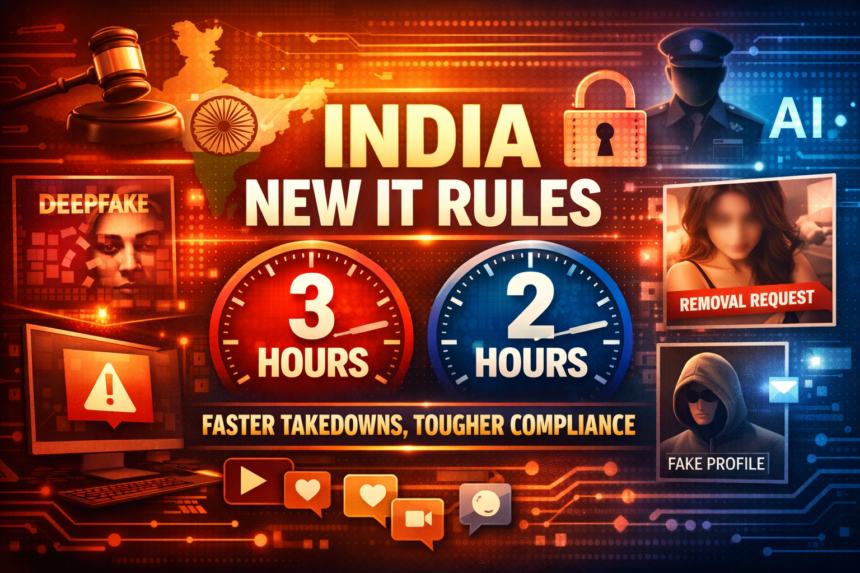
India New IT Rules, If you thought social media platforms already moved fast, India’s new takedown rules just hit the accelerator. The government has amended the Information Technology (Intermediary Guidelines and Digital Media Ethics Code) Rules to dramatically cut the time intermediaries get to remove content once they receive a valid order or request.
And here’s the twist a lot of people are missing: these rules are not just about AI-generated content or deepfakes. They apply to almost everything you see online – videos, posts, images, memes, and more. Whether content is made by a human, an AI model, or a mix of both, the timelines are now brutally short.
What Has Changed Under The New IT Rules?
The amendments, notified by the Ministry of Electronics and Information Technology (MeitY), pull synthetically generated information (SGI) – basically AI-generated or manipulated content – directly into India’s regulatory framework. But they go much further than that.
Two big changes stand out:
Intermediaries must now act on court orders or directives from designated law enforcement agencies within three hours in certain serious categories.
User requests for the removal of impersonation or intimate images must be addressed within two hours.
Compare that with the earlier rules, where platforms typically had up to 36 hours to comply with official takedown orders and around 24 hours for certain user complaints. Overnight, those windows have shrunk to a fraction of what they were.
These Rules Aren’t Just About AI Content
India New IT Rules, At first glance, it might look like the government is targeting AI content alone – especially with all the talk around deepfakes and synthetically generated information. But legal experts are clear: the amendments apply to all content hosted by intermediaries, not just AI outputs.
Clauses 3(1)(d) and 3(2) of the IT Rules, which govern the removal or disabling of access to information, apply broadly to any content on a platform – whether it’s user-generated text, photos, videos, or SGI. In other words, the new timelines are universal, and AI is just one piece of the puzzle.
Three Hours To Act: What Counts As Serious Content?
The three-hour deadline doesn’t apply to every single complaint under the sun. It kicks in for content that touches high-stakes areas such as:
Security and sovereignty of India
Public order and law and order situations
Defamation
India’s foreign relations
Other violations of applicable law as indicated in the order
When a court or authorised law enforcement agency issues a takedown order in these categories, intermediaries now have to move almost in real time. Three hours is barely enough for a coffee break in a large company, yet it’s now the legal standard for compliance.
Two-Hour Deadline For Intimate Images And Impersonation
One very user-focused change is the two-hour response requirement for complaints about:
Intimate or sexually explicit images shared without consent
Content involving impersonation, such as fake profiles or accounts mimicking real individuals
On paper, this is a strong step toward protecting victims of online abuse, deepfake pornography, and identity misuse. If a user flags such content, the intermediary must act within two hours – a timeline that can genuinely reduce harm in cases where every minute of exposure adds to the trauma.
A Very Tight Implementation Window
India New IT Rules, According to legal experts, the final rules are set to take effect from February 20, leaving intermediaries with less than 10 days from notification to full compliance. For many platforms, especially those without large legal or moderation teams, that’s almost mission impossible.
Platforms will need to:
Rework internal workflows
Set up 24×7 response teams
Upgrade or deploy new tech tools
Align policies with the new legal requirements
As one technology lawyer put it, the approach seems somewhat detached from on-ground business realities. You can’t just flip a switch and expect complex global platforms to instantly comply with three-hour deadlines across multiple time zones.
The Challenge Of Detecting AI-Generated Content
While synthetically generated information is now clearly defined under the rules, actually spotting it is a whole different game. There is currently no universal, foolproof standard for detecting AI-generated content in real time.
Think about it like trying to tell whether a photo was taken on a phone or rendered by a super-advanced 3D engine just by glancing at it. Sometimes you can guess, but you’re far from certain.
For AI providers and platforms, creating and implementing robust detection tools, watermarking systems, or provenance tracking mechanisms within such short timelines is a massive ask. And it becomes even harder when users can edit or manipulate AI outputs, stripping away any hidden markers.

Big Platforms vs Small Platforms: Who Bears The Brunt?
India New IT Rules, Large social media companies with global operations already have some form of 24×7 moderation and legal response frameworks. For them, the reduced takedown timelines are tough but perhaps still manageable with heavy investment, automation, and dedicated teams.
Smaller platforms, regional apps, niche communities, and startups, however, face a much heavier burden. To meet three-hour or two-hour deadlines, they may feel forced to:
Rely on automated systems for quick takedowns
Over-remove content to avoid legal risk
Divert limited resources from growth and innovation into compliance
This imbalance could eventually tilt the playing field in favor of big tech, simply because they are better equipped to handle the cost and complexity of constant legal compliance.
Risk Of Over-Moderation And Chilling Effect On Speech
When timelines are this tight, platforms may not have enough breathing room to carefully assess every takedown order or complaint. The safest route from a legal risk standpoint is obvious: take the content down first, ask questions later – if at all.
That leads to a classic “chilling effect” on free speech, where platforms:
Remove borderline or controversial content even if it’s lawful
Hesitate to host content that could attract regulatory attention
Prioritize risk-avoidance over robust public debate
Imagine a moderator having to choose between spending time verifying a complex political post and maintaining compliance with a ticking three-hour clock. The pressure naturally nudges them toward taking the content down rather than defending it.
Decentralised Takedown Powers And Rising Volume Of Requests
India New IT Rules, Another key concern is the expansion of who can issue takedown orders. If multiple police officers and enforcement officials across the country are authorised to demand content removal within three hours, the volume of takedown requests could spike sharply.
For platforms, that means:
More incoming orders from multiple jurisdictions
Need for standard operating procedures to triage and process requests
Round-the-clock monitoring of official communication channels
This decentralisation might speed up action in urgent cases, but it also increases the risk of inconsistent or overbroad orders, placing platforms in a constant reactive mode.
Safe Harbour: Are Intermediaries Becoming Content Regulators?
Under the IT Act, intermediaries enjoy what’s known as safe harbour – legal protection that shields them from liability for user-generated content as long as they follow due diligence and certain rules.
With the new amendments, several experts warn that intermediaries are being pushed from neutral hosts into the role of active content regulators. When you are expected to:
Detect content proactively
Respond to orders within hours
Potentially use AI tools to auto-takedown content
…your role starts to look less like a passive platform and more like a media house that constantly edits, filters, and curates content. This shift could undermine safe harbour protections and expose intermediaries to greater legal risk whenever something slips through the cracks or is removed incorrectly.
Due Process vs Speed: Can You Challenge A Takedown In Three Hours?
Another uncomfortable question: what happens to due process? If a platform believes an order is arbitrary, overreaching, or unconstitutional, it typically has the option to challenge it in court.
But with a three-hour deadline, realistically:
There is almost no time to seek legal advice
Approaching a court within that window is practically impossible
The content is likely gone long before any challenge can be mounted
The result is that speed effectively outruns scrutiny. The system prioritises rapid compliance over careful evaluation, which can weaken the checks and balances that are core to a democratic legal framework.
The Government’s View: A Tiny Slice Of Total Takedowns
Government officials, on their part, argue that concerns are overblown. According to a senior official, the content government agencies ask to be removed forms only about 0.1–0.2% of the total takedowns intermediaries already carry out.
From this perspective, the state is just tightening rules around a very small subset of content, mainly targeting:
Deepfakes
Impersonation and fraud
Unlawful or harmful online content
The official line is that the amendments are a necessary response to rapidly evolving threats in the digital space, especially with AI making it easier to generate realistic but completely fake content.
Tech Upgrades: Watermarking, Provenance, And 24×7 Readiness
India New IT Rules, To realistically comply with these rules, many intermediaries may be force to seriously upgrade their tech stack. That can include:
End-to-end watermarking of AI-generated outputs for easier detection
Provenance mechanisms to track where content originate and how it was modified
Automated triage systems to rank and route takedown requests
24×7 legal and moderation teams on call for urgent orders
All of this comes at a cost. For platforms operating in India, the cost of doing business could rise significantly, especially for those who operate on thin margins or are still in growth mode.
A New Phase For India’s Intermediary Liability Regime
Put together, these amendments mark a major shift in how India regulates intermediaries and online content. Content moderation practices across social media, messaging apps, video platforms, and other digital services will likely need a fundamental overhaul.
The key tensions going forward will revolve around:
Speed vs accuracy in takedown decisions
Innovation vs compliance costs for platforms
User safety vs free speech and due process
How platforms adapt, how courts interpret these rules, and how enforcement agencies exercise their powers will ultimately shape the balance between regulation and digital rights in the years ahead.
Similar Articles: Samsung Galaxy S26 Privacy Display: A Revolutionary On-Screen Privacy Feature Explained
Conclusion
India New IT Rules, India’s new takedown rules send a clear signal: the era of leisurely content moderation is over. Intermediaries now operate under intense time pressure, with their safe harbour protections indirectly tied to their ability to act within hours, not days.
While the government frames this as a necessary response to deepfakes, impersonation, and harmful content, the broader impact goes far beyond AI. Every platform, big or small, and every piece of content, human or machine-made, falls under the same compressed timelines.
The result is a high-stakes balancing act. Platforms must protect users, obey the law, and respect free speech – all while racing against the clock. Whether this new regime will create a safer digital space or simply push platforms into over-censorship remains to be seen, but one thing is clear: the rules of the online game in India have changed, and everyone – from tech giants to everyday users – will feel the impact.