
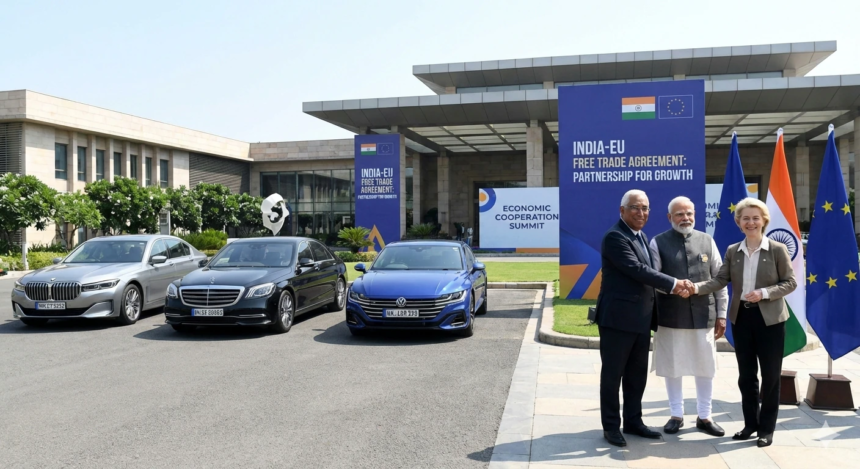
India EU Free Trade Agreement, India is gearing up for one of its biggest trade moves in years, and it’s going to be felt most on the roads. The Government is poised to slash import tariffs on cars from the European Union, cutting them from levels as high as 110% down to 40%.
If you’ve ever wondered why imported cars in India are brutally expensive, this is the kind of policy that kept them that way. Now, that wall is finally starting to come down.
According to people familiar with the talks, this tariff cut is tied to a major free trade agreement between India and the EU that could be unveiled as early as Tuesday, January 27, 2026. For European carmakers, it’s a long-awaited opening into one of the world’s fastest-growing auto markets. For Indian consumers, it could mean more choice—and potentially better prices.
The India EU trade deal is expected to play a crucial role in reshaping automobile imports, boosting bilateral trade, and opening India’s car market to greater global competition.
What Exactly Is India Changing On Car Tariffs?
Right now, imported cars face steep duties in India, typically at two levels:
-
Around 70% on some models
-
Up to a staggering 110% on others
These taxes have long been criticised by global industry leaders, including Tesla’s Elon Musk, as a major barrier to entering the Indian market.
Under the new arrangement being discussed with the EU, India plans to:
-
Immediately reduce import duties on a limited number of cars from the EU
-
Apply this to vehicles with an import price above 15,000 euros (about 17,739 dollars)
-
Cut tariffs on these cars down to 40% right away
Over time, those tariffs will reportedly be reduced even further, potentially dropping to 10%, dramatically reshaping the economics of importing high-value cars into India.
The ‘Mother Of All Deals’: Inside The India–EU Trade Pact
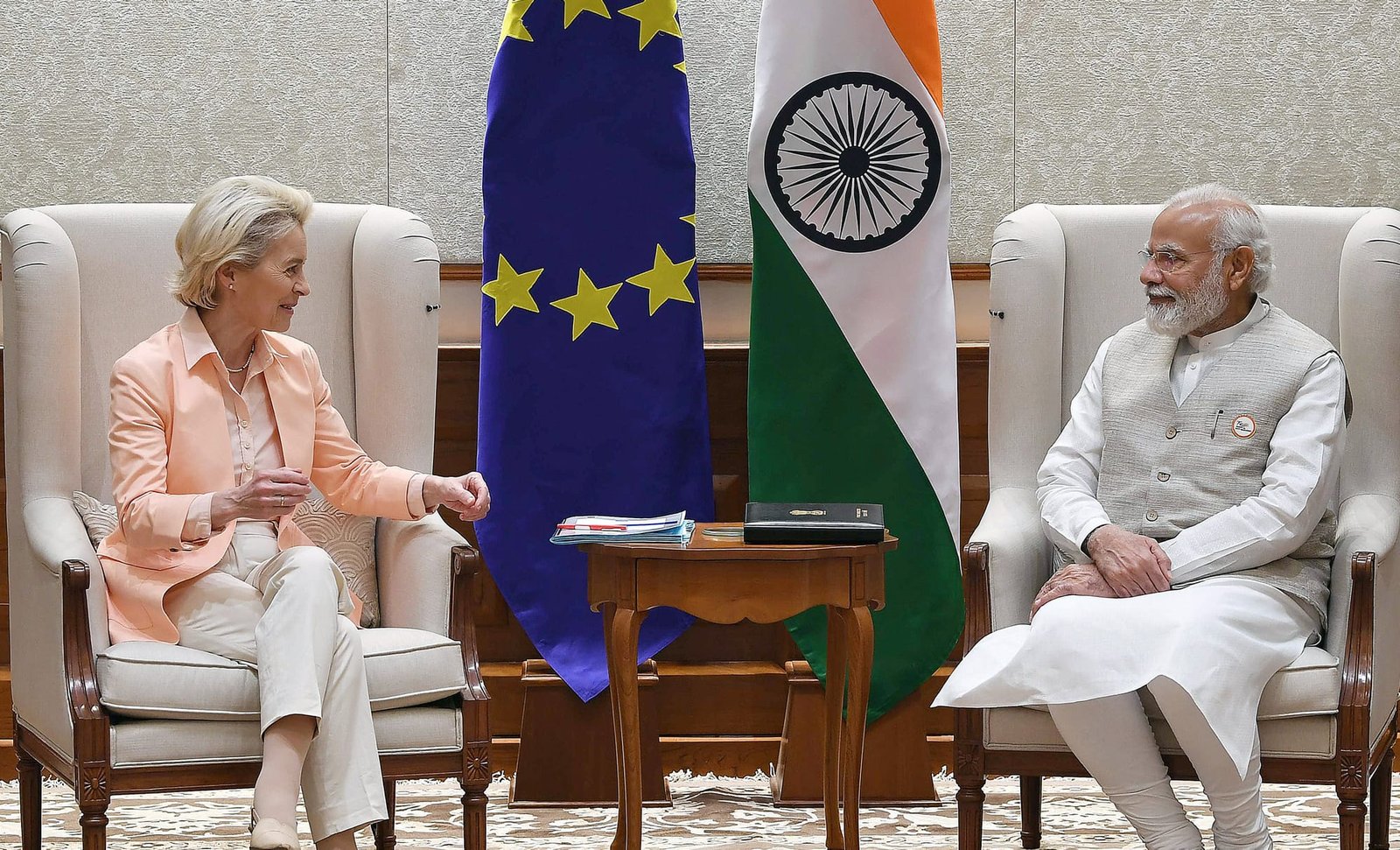
India EU Free Trade Agreement, This tariff cut doesn’t come in isolation. It’s part of a much larger India–EU free trade agreement that negotiators have spent years working on. The deal is already being dubbed the “mother of all deals”, and not without reason.
Here’s why it’s such a big deal:
-
It covers a wide range of sectors, not just automobiles.
-
It’s expected to expand bilateral trade significantly.
-
It could give a major lift to Indian exports of goods like textiles and jewellery, which have been hit hard by 50% U.S. tariffs since late August.
Once both sides announce the conclusion of the negotiations, the text of the agreement will be finalised, followed by ratification. Only then will the full picture—and the fine print—become public.
Why India’s Car Market Matters So Much
To understand why Europe cares so deeply about this deal, you have to look at India’s auto landscape.
India is:
-
The world’s third-largest car market by sales, after the United States and China
-
A market with massive growth potential, especially as incomes rise and urbanisation continues
But there’s a catch: India’s auto sector has been one of the most protected in the world. High tariffs have effectively shielded domestic manufacturers and discouraged mass imports of fully built cars.
For global automakers that want a slice of India’s future, these high barriers have been a constant source of frustration. The new tariff plan could finally begin to change that.
How Big Is The Tariff Cut In Practical Terms?
One of the sources familiar with the talks says India has proposed:
-
An immediate reduction of import duties to 40%
-
This applies to around 200,000 combustion-engine cars per year
-
The quota and numbers could still change at the last moment
If you imagine the Indian auto market as a tightly guarded fortress, this proposal is like opening a wide new gate—at least for petrol and diesel cars coming from Europe.
Lower tariffs mean:
-
Imported vehicles can be price more competitively
-
Carmakers can test more models in the Indian market
-
Companies get the chance to build demand before committing to large-scale local manufacturing
It’s not a total free-for-all, but it’s a far more generous opening than what India has offered in the past.
Why Electric Vehicles Are Being Treated Differently
Interestingly, there’s one big exception in this initial wave of tariff cuts: battery electric vehicles (EVs).
According to the sources, EVs will:
-
Not benefit from import duty reductions for the first five years
-
Be protect to safeguard existing and plan investments by Indian companies like Mahindra & Mahindra and Tata Motors
-
Only after five years will EVs be brought under a similar duty reduction framework
From a policy perspective, this makes sense for New Delhi. The government wants to build a strong domestic EV ecosystem, and cheaper imported EVs too early in the game could undercut local players just as they are scaling up.
So, while petrol and diesel cars from Europe may get a head start, EVs will have to wait before they receive the same tariff advantages.
Who Stands To Gain In Europe?
If you’re thinking about which European brands are likely smiling right now, several names stand out.
Beneficiaries include:
-
Mass and mid-range players like Volkswagen, Renault, and Stellantis
-
Luxury brands such as Mercedes-Benz and BMW, which already have a presence in India
Many of these companies already manufacture some models locally in India, but high tariffs on fully built imports have limited their ability to bring in a large variety of vehicles or to scale up their premium offerings.
With lower import duties, these carmakers can:
-
Import a wider range of models
-
Use India as a testing ground for niche or premium vehicles
-
Build a stronger customer base before deciding on major local investments
For Europe’s auto industry, increasingly under pressure at home from Chinese competition and stricter regulations, India offers a big growth opportunity.
Where Do Indian And Japanese Brands Stand?
Right now, the Indian car market is dominate by:
-
Suzuki Motor (via Maruti Suzuki), the Japanese giant
-
Local champions Mahindra & Mahindra and Tata Motors
Together, these players control about two-thirds of a market that sells around 4.4 million cars a year. European brands, in contrast, hold less than 4% of that pie.
That imbalance reflects how difficult it has been for European carmakers to gain real traction in India, despite years of trying. High tariffs, price sensitivity among buyers, and strong local competition all played a part.
With the new tariff regime, European brands could slowly chip away at that dominance. But it won’t be easy—Indian and Japanese manufacturers still benefit from established dealer networks, local know-how, and deep brand loyalty.
A Market Poised To Grow To 6 Million Cars
India EU Free Trade Agreement, If you think 4.4 million cars a year is huge, projections suggest India’s market could grow to 6 million units annually by 2030. That’s not just growth; it’s a massive expansion of demand.
This expected boom is one of the reasons global manufacturers are jostling for position now rather than later. The new trade deal may act as a catalyst for foreign investment and new model launches over the next few years.
Some companies are already moving:
-
Renault is planning a fresh push in India, repositioning its strategy as it searches for growth outside an increasingly competitive European market.
-
The Volkswagen Group is shaping its next phase of investment through its Skoda brand, which leads many of its India operations.
With tariffs trending downward and a trade pact offering more certainty, these companies can plan with more confidence.
What Does This Mean For Indian Buyers?
Let’s bring this down to the showroom level. What might this mean for someone walking into a dealership in a few years?
Potential impacts could include:
-
More imported options in mid-range and premium segments
-
Lower prices on some European models compared with today’s post-tariff sticker shock
-
A broader mix of technology, safety features, and designs entering the market
However, don’t expect prices to suddenly collapse. Even at 40%, import duties remain significant. On top of that, there are logistics costs, dealer margins, and other taxes. But compared to the current 70–110%, this is still a meaningful shift.
Over time, if tariffs come down closer to 10%, the change in affordability and variety could be much more dramatic.
Could This Push More Local Manufacturing?
Here’s the twist: tariff reductions might actually encourage, not discourage, more local manufacturing in the long run.
How?
-
Carmakers can start with imports to build brand and demand.
-
Once they hit certain sales volumes, it often becomes cheaper to build locally than continue importing.
-
The trade deal may also contain provisions encouraging investment and technology transfer.
In a way, lower tariffs are like opening a trial period for global brands. If they see traction, history suggests many will eventually deepen their local footprint—setting up plants, sourcing more locally, and creating jobs.
So while local manufacturers might feel some heat in the short term, the broader ecosystem of suppliers, workers, and ancillary industries could benefit from a richer, more competitive market.
The Fine Print: Still Under Wraps
Before we assume everything is final, it’s worth remembering that:
-
The negotiations are still confidential.
-
The sources speaking to Reuters decline to be named because discussions are ongoing.
-
Both India’s Commerce Ministry and the European Commission have declined to comment publicly so far.
That means details like the exact quota, the timeline for tariff reductions, and the precise treatment of different vehicle categories could still change right up to the last minute.
But even with some uncertainty, the direction of travel is clear: India is opening up its car market to Europe more than ever before.
Similar Articles: India EU Trade Deal: Why the ‘Mother of All Agreements’ Could Reshape Global Trade
Conclusion
India EU Free Trade Agreement, India’s move to slash car import tariffs for the European Union marks a turning point on multiple fronts. It signals a more confident, outward-looking trade policy from New Delhi, even as it continues to protect strategic sectors like electric vehicles in the near term.
For European automakers, this is the chance they’ve been waiting for—to tap into a huge, growing market that has remained frustratingly out of reach. For Indian buyers, it could mean more choices, better technology, and eventually more competitive pricing. And for the broader economy, the deal could unlock new export opportunities and fresh investment flows.
The exact contours of the “mother of all deals” will only be fully clear once the text is published and ratified. But if the reported tariff cuts go through as planned, India’s roads—and its trade relationship with Europe—are heading into a new era.