
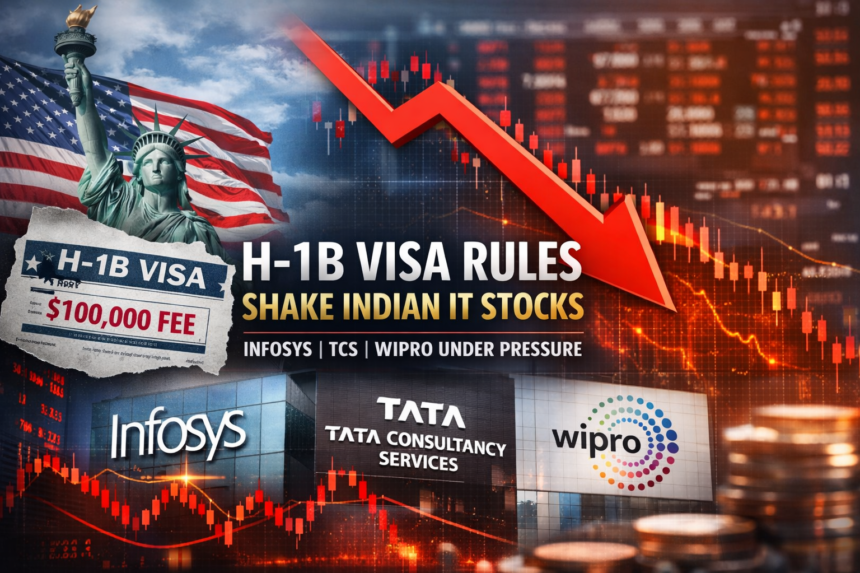
Indian IT giants like/Infosys,/Tata Consultancy Services (TCS),/Tech Mahindra, and/Wipro/faced another rough trading day on Wednesday, December 24, 2025. Shares of leading and mid-cap IT companies dropped up to 2% after the U.S. government announced a major US H-1B policy change affecting the visa selection process.
So, what exactly happened? The/U.S. Department of Homeland Security (DHS)/rolled out this new rule that shakes up how H-1B visa applications will be selected and it’s already causing ripples across the global tech industry.
What Are the New H-1B Visa Rules?
Under the newly announced policy, the traditional random lottery system will be replaced by a weighted selection process. This means that applications offering higher salaries or greater skill levels will stand a much better chance of getting selected.
In simple terms, the U.S. wants to prioritize “top talent” professionals with deeper expertise and higher wages over entry-level applicants who often come with lower pay scales.
Why Is the U.S. Making This Change?
H-1B Visa Rules, According to the U.S. Citizenship and Immigration Services (USCIS), the lottery-based system was vulnerable to misuse by companies that hired cheaper foreign workers. DHS says that the new process will help protect American workers by discouraging low-wage import of labor and rewarding skill-based hiring.
The revised rule will come into effect on February 27, 2026, applying to the FY2027 H-1B cap registration season.
A Step Aligned With Trumps Policy Vision
This change aligns closely with former U.S. President Donald Trumps long-standing commitment to reform the H-1B program. Trump has been vocal about ensuring that American jobs go first to Americans and that foreign workers entering under the H-1B category should be the best and brightest.
Adding to that, the Trump administration has also approved a new $100,000 per-visa fee, aiming to discourage mass filings by corporations heavily dependent on imported talent.
The Wage Level Breakdown Explained
Before the policy update, the H-1B visas were distributed roughly as follows:
Wage Level I (Entry Level): 3540% of visas
Wage Level II (Qualified): 35%
Wage Level III (Experienced): 1520%
Wage Level IV (Highly Skilled): 10% or less
This simply means that nearly 70% of all H-1B visas went to entry-level and moderately skilled workers, while the most highly paid professionals received only a small fraction.
How the New Weighted Process Will Work
Heres where things get interesting. Under the new system, each unique beneficiary (applicant) will have more entries into the selection pool based on their wage level.
Level IV workers (top earners) will get the highest priority their names could appear multiple times in the selection pool.
Level I workers, on the other hand, will get no additional advantage, drastically reducing their odds of being picked.
In practice, this change flips the odds rewarding the highest-paid and most skilled professionals while pushing entry-level foreign workers to the back of the line.
$100,000 H-1B Visa Fee Now Official
H-1B Visa Rules, A separate ruling by U.S. District Judge Beryl Howell confirmed that the Trump administrations $100,000 visa fee per application is lawful. This means that the cost of sponsoring each visa could skyrocket, placing an extra financial burden on tech companies that rely heavily on H-1B workers.
When this fee hike was first floated in September, market experts warned it could hit profits hard.
What the Experts Are Saying
According to Sandip Agarwal, fund manager at Sowilo Investment Managers, the impact could be quite severe. He estimated that the top five Indian IT companies, which together generate nearly $80 billion in annual revenue, could see margins dip by 67% due to this policy.
Heres the math: about 10,000 visas multiplied by the new $100,000 fee translates to a $1 billion additional expense. Given an average 20% margin on $80 billion, thats a notable dent in profitability roughly 67% off the bottom line. Quite a hit, indeed.
How the Market Reacted
The immediate reaction was unmistakable. On the Nifty IT Index, Coforge led the decline, dropping nearly 2%. Infosys, Wipro, Mphasis, and Persistent Systems also slipped between 1% and 2%, extending their losing streak for the second straight session.
Investors are clearly concerned that costlier visas and tighter selection processes could squeeze margins, drive up operational costs, and slow down U.S. talent mobility something that Indian IT firms thrive on.
Impact on Indian IT Giants
The new rules present a double-edged sword. On one side, they could help companies retain their most valued, high-performing employees in the U.S. market. On the other, for firms that depend on higher volumes of entry- to mid-level talent like Infosys and Wipro profit margins might come under pressure.
With the U.S. being a primary revenue source for most Indian IT companies, even a small change in visa regulations can have a large ripple effect across earnings and investor sentiment.
The Bigger Picture: What Lies Ahead?
These changes are part of a broader U.S. policy shift toward favoring high-value, innovation-driven immigration. While that may sound beneficial for the American economy, it raises tough questions for global IT outsourcing.
Can Indian firms adapt by increasing onshore hiring in the U.S. or investing more in automation and AI-driven services? Time will tell, but one things certain the future of cross-border tech staffing wont look the same.
Similar Articles: Dreaming of Working in the UK? The Free Ballot for India Young Professionals Scheme Is Now Live!
Conclusion
The H-1B visa reform marks a major turning point for Indian IT companies that rely on U.S. operations. As the new wage-based system and $100,000 visa fee come into play, the industry must re-evaluate its recruitment, cost structure, and business strategy.
For now, investors are skeptical, and the stock market reflects that sentiment. Whether this reform fosters genuine innovation or simply raises barriers will shape the U.S.India technology relationship for years to come.